Abbad C, Berna E, Neria F, Perez J, Davó M, Treichel A, Monge D, Ballester MA, Pindado C, Castellanos M, Llamas M, Solís J, Fernández L, Barderas MG, Pérez V, Artacho A, Moya A, Jaén P, Mehta NN, Blauvelt A, Serrano S, Moreno ÓM, González Á. Distinct Gut Microbiota Signatures are Associated With Progression of Atherosclerosis in Patients With Psoriasis: Results From the EDSAP Study
Br J Dermatol. 2026
"A gut microbiota signature may help identify which patients with psoriasis will experience subclinical atherosclerosis progression". - Dr. Carlota Abbad-Jaime De Aragón & Dr. Álvaro González Cantero
Summary:
Background: The relationship between gut microbiota composition and the progression of subclinical atherosclerosis in patients with psoriasis remains unknown.
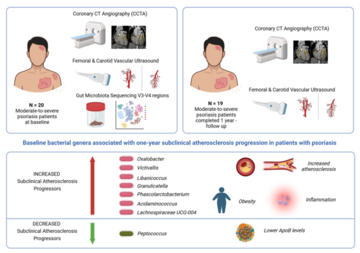
Methods: To address this gap, a 52-week longitudinal study was conducted to assess gut microbial signatures and subclinical atherosclerosis progression in 20 psoriasis patients undergoing biologic treatment. Baseline and one-year follow-up atherosclerosis burden assessments (low/high) were determined using vascular ultrasound of the femoral/carotid arteries as well as by coronary computed tomography angiography (CCTA) of coronary vasculature. Atherosclerosis progression (progressors/non-progressors) was defined by increases in number of sites affected or by increases in number of atheroma plaques detected. Fecal samples were collected from participants at baseline; amplification and sequencing of 16S ribosomal DNA (V3-V4 variable regions) were carried out to assess gut microbiome.
Results: All participants provided fecal samples. Follow-up imaging analyses were completed by 19/20 participants. There was an equal distribution of low and high atherosclerosis burden at baseline. No significant differences were observed in adjusted alpha and beta microbial diversity indices between low/ high burden groups. By contrast, differences in gut microbiota structure between atherosclerosis progressors and non-progressors were detected by alpha (Shannon index) and beta (Bray-Curtis distances) analyses. Additionally, differences in bacterial signatures associated with atherosclerosis progression, including Lachnospiraceae UCG-004, Libanicoccus, Victivallis, Oxalobacter, Phascolarctobacterium, Acidaminococcus, and Granulicatella were demonstrated. The impact of biologics on gut microbiota composition and atherosclerosis progression was not assessed.
Conclusions: Progression of atherosclerosis in patients with psoriasis was associated with distinctive signatures in gut microbiota.
Why do you highligth this publication?
Patients with moderate-to-severe psoriasis have increased premature mortality, mainly due to cardiovascular disease, and the mechanisms underlying this excess risk remain incompletely understood. Recent evidence in the general population has linked the gut microbiota to the progression of atherosclerosis, but this relationship had not been explored in psoriasis. In this study, we showed for the first time a distinct baseline microbial signature associated with subclinical atherosclerosis progression over one year. Although exploratory, these findings suggest that the gut-vascular axis may represent an early marker of cardiovascular risk in psoriasis and warrant validation in larger prospective cohorts.
Publication commented by:
Dr Carlota Abbad-Jaime de Aragón & Dr. Álvaro González Cantero
EXPERIMENTAL DERMATOLOGY AND CUTANEOUS BIOLOGY. IRYCIS