Hernández M, Pérez B, Nieto M, García M, Michelena M, Martínez L, Baquero F, Ruiz P, Cantón R. Addressing therapeutic options for KPC-3-producing ST307- Klebsiella pneumoniae: insights from in vitro evolution and mutant prevention strategies
Antimicrob Agents Chemother. 2026
“Ceftazidime-avibactam plus meropenem suppresses resistance emergence while novel β-lactam/β-lactamase inhibitor regimens drive distinct resistance pathways in KPC-producing Klebsiella pneumoniae".- Dr Marta Hernández-García & Dr Rafael Cantón
Summary:
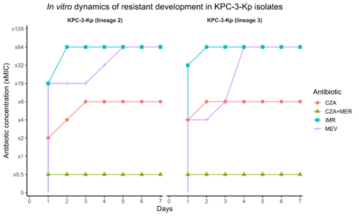
Ceftazidime-avibactam, meropenem-vaborbactam, and imipenem-relebactam are key therapeutic options for infections caused by KPC-producing Klebsiella pneumoniae (KPC-Kp). Resistance may emerge during therapy, but knowledge on mutant prevention and collateral effects remains limited. Killing kinetics assays of ceftazidime-avibactam, meropenem-vaborbactam, imipenem-relebactam, and the combination of ceftazidime-avibactam with meropenem (CZA + MER) were performed against clinical KPC-3-ST307-Kp isolates and ceftazidime-avibactam-resistant KPC-ST307-Kp mutants (KPC-31/KPC-46/KPC-53/KPC-61/KPC-62/KPC-66/KPC-92/KPC-150-Kp) with different genetic backgrounds. Single-step mutant frequencies and resistance trajectories were established. WGS was used to identify resistance mechanisms, and collateral resistance to other last-line agents was assessed. In time-kill assays, meropenem and ceftazidime-avibactam showed bactericidal activity at high concentrations (2× MIC and 4× MIC). Meropenem-vaborbactam was bactericidal only at high exposures (2× MIC and 4× MIC) and with reduced activity in porin-deficient strains, whereas imipenem-relebactam was bactericidal in half of the strains at 4× MIC. CZA + MER showed synergistic bactericidal activity across all KPC-Kp isolates, even at subinhibitory concentrations. CZA + MER completely suppressed the emergence of resistant mutants (mutation rate <10⁻¹⁰), while stepwise selection with ceftazidime-avibactam, meropenem-vaborbactam, and imipenem-relebactam rapidly led to resistance. Meropenem-vaborbactam and imipenem-relebactam selected mutants at lower concentrations and higher frequencies than ceftazidime-avibactam. Ceftazidime-avibactam resistance was mainly driven by blaKPC diversification, whereas meropenem-vaborbactam and imipenem-relebactam selected truncating mutations in OmpK36. Imipenem-relebactam exerted stronger collateral effects than meropenem-vaborbactam, extending cross-resistance to aztreonam-avibactam and cefepime-taniborbactam, while cefiderocol activity remained largely preserved. Plasmid copy number contributed minimally to resistance phenotypes. Ceftazidime-avibactam, meropenem-vaborbactam, and imipenem-relebactam impose distinct evolutionary pressures on KPC-ST307-Kp, resulting in divergent resistance pathways and collateral resistance profiles. CZA + MER may offer a more sustainable strategy by preventing resistance emergence and limiting cross-resistance to last-line agents.
Why do you highligth this publication?
This work provides novel insights into the evolutionary resistance pathways to key therapeutic options for KPC-K. pneumoniae infections and into the collateral consequences of antibiotic pressure in the high-risk clone ST307. Notably, trajectories with meropenem-vaborbactam and imipenem-relebactam were associated with cross-resistance to other last-line antimicrobials targeting MBL producers, including aztreonam-avibactam and cefepime-taniborbactam. In contrast, the combination of ceftazidime-avibactam plus meropenem showed synergistic bactericidal activity and completely suppressed the emergence of resistant mutants, supporting the potential value of collateral sensitivity-based strategies. Our findings highlight the importance of performing resistance-prevention and mutant-selection studies, as standard susceptibility testing alone may overlook the risk of rapid resistance emergence and the development of resistance to new antimicrobial agents.
Publication commented by:
Dr Marta Hernández García & Dr Rafael Cantón Moreno
BIOLOGY AND EVOLUTION OF MICROORGANISMS group. IRYCIS