Rodriguez de Santiago E, Teruel Sanchez C, Albeniz E, Estremera F, Arrubla A, Castel de Lucas I, Arribas J, Marin JC, Diez P, Nunez H, Herreros de Tejada A, El Haira I, Riu F, Naves J, Uchima H, Marin I, Duque JM, Perez D, De Maria P, Perez I, Garcia C, Lorenzo V, Nogales O, Muriel A, Albillos A. Multicenter, double-blind, sham endoscopy-controlled, randomized trial evaluating the efficacy of antireflux mucosal ablation for the treatment of gastroesophageal reflux disease
Endoscopy. 2025
"Negative trials are essential to move medicine forward: by challenging promising interventions with rigorous methodology, we ensure that innovation in endoscopy is driven by evidence rather than expectations." - Dr Enrique Rodríguez de Santiago & Dr Carlos Teruel Sánchez-Vegazo
Summary:
Background: Antireflux mucosal ablation (ARMA) is a novel endoscopic technique for gastroesophageal reflux disease (GERD) but has only been assessed in noncontrolled studies. The objective of this randomized controlled study was to evaluate its efficacy in patients with proton pump inhibitor (PPI)-responsive GERD.
Methods: We conducted a double-blind, sham endoscopy-controlled, randomized trial across 12 Spanish hospitals. Adults with PPI-responsive GERD and abnormal esophageal acid exposure time (AET > 6 %) were randomly assigned (1:1) to receive ARMA or sham endoscopy. The primary outcome was clinical success at 12 months, defined as a ≥ 50 % reduction in the GERD-Health-Related Quality of Life score. Inability to discontinue PPIs to allow symptom assessment was considered treatment failure. Secondary outcomes included PPI discontinuation, AET, manometric parameters, mucosal healing, and adverse events.
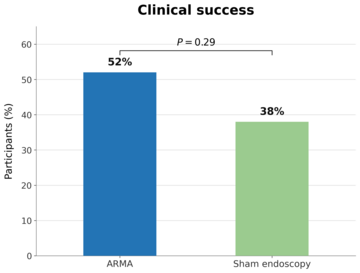
Results: Of 186 patients screened, 60 were included (ARMA 31; sham 29). At 12 months, clinical success was achieved in 16 patients (51.6 %) in the ARMA group and in 11 (37.9 %) in the sham group (P = 0.29; risk ratio 1.36, 95 %CI 0.76 to 2.42). No significant differences were observed in PPI discontinuation, AET, manometric findings, or mucosal healing. Postprocedural pain (27.3 % vs. 3.3 %) and dysphagia (45.5 % vs. 10.0 %) occurred more frequently in the ARMA group. No severe adverse events were recorded.
Conclusions: ARMA was not superior to sham endoscopy in improving GERD-related quality of life at 12 months in patients with PPI-responsive GERD, and was associated with a higher incidence of adverse events. These findings do not support its implementation in routine clinical practice.
Why do you highligth this publication?
This is one of the few double-blind, sham-controlled randomized trials performed in the field of therapeutic endoscopy. While previous uncontrolled studies suggested promising results for ARMA, this trial demonstrates that its clinical benefit is more modest when evaluated under rigorous conditions, emphasizing the relevance of placebo effects in procedural interventions. Importantly, the study establishes a new methodological standard for the assessment of emerging endoscopic therapies, ensuring that innovation is guided by robust scientific evidence and patient benefit.
Publication commented by:
Dr Enrique Rodríguez de Santiago & Dr Carlos Teruel Sánchez-Vegazo
LIVER AND DIGESTIVE DISEASES GROUP. IRYCIS