Bervoets S, Duijkers L, Velde HM, Corradi Z, van EM, Suárez-Herrera N, Garanto A, Moreno-Pelayo MA, Pennings R, Collin RWJ, Vázquez-Dominguez I. Exploring extracellular vesicle MicroRNAs in Usher syndrome type 1B:Tear-Derived EVs as potential indicators of retinal health
Cell Mol Life Sci. 2026.
"Tear-Derived Extracellular Vesicles Reveal Retina-Specific miRNA Signatures in Usher Syndrome Type 1B". - Dr. Irene Vázquez Domínguez
Summary:
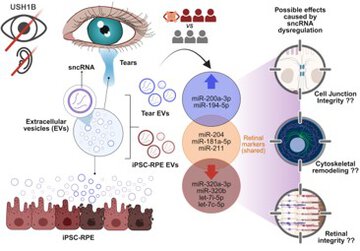
Usher syndrome type 1B (USH1B) is a rare inherited disorder characterized by congenital deafness and progressive retinitis pigmentosa, caused by biallelic pathogenic variants in the MYO7A gene. We explored extracellular vesicles (EVs) from two sources: human tears and iPSC-derived RPE cells from USH1B patients and controls. Tear EVs were assessed as a non-invasive biomarker source, while RPE-derived EVs provided insights into disease mechanisms in a controlled, cell-type-specific context. Although RPE differentiation was successful and MYO7A expression levels were similar between patients and controls, Myosin VIIA was not detected by western blot in the patient-derived cells. We examined the EV cargo by small non-coding RNAs (sncRNAs) sequencing from iPSC-RPE apical site and tears to identify molecular signatures of retinal degeneration. Tear EVs showed higher load and diversity of miRNAs than RPE-derived EVs, reflecting a broader ocular origin. Comparative analysis revealed shared retinal sncRNAs (hsa-miR-204, hsa-miR-211, hsa-miR-181a-5p) and group-specific differences. Notably, when comparing to controls, hsa-miR-200a-3p and hsa-miR-194-5p were upregulated in patient tear EVs, while let-7i/c-5p and hsa-miR-320a/b, were downregulated in-patient RPE-derived EVs. Pathway analysis linked these sncRNAs to retinal structure and function, including cytoskeletal remodeling and junctional integrity. Our findings highlight the potential of tear EVs as a non-invasive source of biomarkers that capture retinal molecular alterations in USH1B, with applications for diagnosis, monitoring, and therapeutic development. Although this is a pilot study focused on uncovering promising biomarkers rather than establishing definitive cause-effect mechanisms, it provides a foundation for future research with larger cohorts to validate and expand these findings.
Why do you highlight this publication?
Despite being a pilot study, this work provides key advances in the field of inherited retinal diseases, specifically Usher syndrome type 1B (USH1B). We show that EVs in tears contain retina-specific miRNAs, regardless of disease status. Importantly, the miRNA profiles of tear-derived EVs differ between controls and USH1B patients, and the differentially expressed miRNAs are associated with pathways essential for retinal homeostasis.
The relevance of these miRNAs was further supported by the correlation of the EV-associated miRNAs identified in iPSC-derived retinal pigment epithelium (RPE) from the same individuals. Altogether, our findings identify tears as a promising, non-invasive source for biomarker discovery, with potential applications in diagnosis, disease and treatment monitoring, and therapeutic development for rare retinal disorders.
Publication commented by:
Dr. Irene Vázquez Domínguez
GENETICS AND SENSORINEURAL PATHOPHYSIOLOGY. IRYCIS