Perez J, Berna E, Abbad C, Goni L, Vazquez Z, Neria F, Cova R, Naharro J, Ballester A, Pindado C, Monge D, Blauvelt A, Jaen P, Mehta N, Gelfand JM, Martinez MA, Gonzalez Á. Mediterranean Diet and Patients With Psoriasis: The MEDIPSO Randomized Clinical Trial
JAMA Dermatol. 2025
"A Mediterranean Diet-based intervention reduces disease severity in psoriasis". - Drs. Javier Pérez Bootello & Álvaro González Cantero
Summary:
Importance: Despite growing interest on the role of diet in the prevention and treatment of psoriasis, randomized clinical trials are lacking. The Mediterranean diet is known for its anti-inflammatory and cardiometabolic benefits, which may be relevant to psoriasis pathophysiology.
Objective: To assess whether a 16-week Mediterranean diet intervention would improve psoriasis severity in patients with mild to moderate disease.
Design, setting, and participants: MEDIPSO (Impact of the Mediterranean Diet on Patients With Psoriasis), an open-label, single-center, single-blinded (evaluator) randomized clinical trial, was conducted from February 2024 to March 2025 at a dermatology referral clinic in Madrid, Spain. Participants were adults with mild to moderate psoriasis (Psoriasis Area and Severity Index [PASI] of 2-10, with higher scores indicating maximal disease) receiving stable topical therapy.
Interventions: Participants were randomized 1:1 to the intervention or control group. The intervention group received a 16-week, dietitian-guided Mediterranean diet program, including nutritional counseling, educational materials, and weekly provision of extra virgin olive oil. The control group received standard low-fat dietary advice without dietitian supervision.
Main outcomes and measures: The primary outcome was the change in the PASI from baseline to week 16. Secondary outcomes included changes in Mediterranean diet adherence, anthropometric and metabolic parameters, serum inflammatory cytokines, and patient-reported outcomes. Estimated marginal means (EMMs) at baseline and for the change from baseline to week 16 were reported, with the intervention effect presented as the between-group difference.
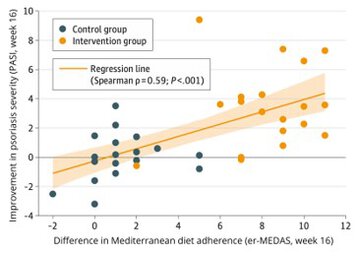
Results: Among 45 individuals screened, 38 participants were enrolled and randomized (mean [SD] age, 46.4 [12.8] years; 25 males [65.8%]); 19 were randomized to the intervention group and 19 were randomized to the control group; 37 individuals (97.4%) completed the study. The EMM PASI change at week 16 was -3.4 (95% CI, -4.4 to -2.4) in the intervention group and 0.0 (95% CI, -1.0 to 1.0) in the control group; the between-group EMM difference was -3.4 (95% CI, -4.8 to -2.0; P < .001). Nine of 19 participants in the Mediterranean diet group (47.4%) achieved PASI 75 (a 75% reduction in PASI) compared with none in the control group. A significant reduction in EMM hemoglobin A1c (glycated hemoglobin) was observed in the intervention group as compared with the control group (between-group EMM difference, -4.1 mmol/mol [95% CI, -6.9 to -1.3 mmol/mol]; P = .01).
Conclusions and relevance: This randomized clinical trial found that a 16-week Mediterranean diet intervention significantly improved psoriasis severity in patients with mild to moderate disease receiving stable topical therapy. These findings suggest that incorporating dietary strategies may be beneficial as an adjunctive therapy in psoriasis management.
Why do you highlight this publication?
This publication provides the first randomized clinical trial evidence demonstrating the therapeutic impact of a Mediterranean diet in psoriasis. The MEDIPSO study shows that a structured dietary intervention leads to a clinically meaningful improvement in disease severity, with additional benefits on metabolic control such as glycated hemoglobin. These findings support dietary strategies as an evidence-based adjunct to standard psoriasis treatment and reinforce the systemic inflammatory nature of the disease.
Publication commented by:
Drs. Javier Pérez Bootello & Álvaro González-Cantero
EXPERIMENTAL DERMATOLOGY AND CUTANEOUS BIOLOGY. IRYCIS