Navarro R, Muriel A, Montejano R, Bernardino JI, Gutiérrez F, Del Amo A, Fernández BM, González M, Izquierdo R, Fernández S, Martínez J, Castillo AM, Saumoy M, Moreno S, Serrano S, CoRIS C. Prevalence and mortality of tuberculosis at HIV diagnosis in Spain, 2004-2024
Int J Infect Dis. 2026
“Reducing deaths from tuberculosis at HIV diagnosis now depends on reaching the groups that progress has left behind". - Dr Roser Navarro-Soler & Dr Sergio Serano-Villar
Summary
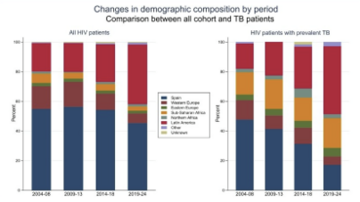
Tuberculosis coinfection at the time of HIV diagnosis remains an important driver of early morbidity and mortality, yet little is known about how its burden has evolved in low-incidence European settings with universal access to antiretroviral therapy. In this work, we examined tuberculosis present at or near HIV diagnosis over two decades in the Spanish CoRIS cohort, a nationwide cohort of adults enrolled at HIV diagnosis before starting treatment. The frequency of tuberculosis at HIV diagnosis fell markedly over the study period. However, those still affected presented with increasingly advanced immunosuppression. Risk was concentrated in specific groups: migrants from high-burden regions, particularly Sub-Saharan Africa, people who inject drugs, older adults, and people with high viral load or a positive tuberculosis screening test. In contrast, higher educational attainment and preserved CD4 counts were protective. A prediction model built on these factors identified people at risk with good accuracy and showed good calibration on internal validation. Tuberculosis at HIV diagnosis was associated with clearly higher mortality throughout follow-up, even after accounting for other risk factors. Among those affected, injection drug use and lower educational attainment were associated with a higher risk of tuberculosis-related death. These findings show that, despite substantial progress, tuberculosis at HIV diagnosis remains concentrated in socially and immunologically vulnerable groups and continues to confer excess mortality. They support targeted screening, prompt antiretroviral therapy and integrated prevention strategies, particularly for migrants from high-burden regions.
Why do you highligth this publication?
This study provides a long-term, nationwide assessment of tuberculosis present at HIV diagnosis in a low-incidence European setting. It shows that the substantial progress achieved over two decades has not been evenly shared, and that the moment of HIV diagnosis remains a window where both infections converge in the most vulnerable patients. The study also shows that tuberculosis at diagnosis is not only a marker of advanced disease but an independent predictor of death, and that excess mortality has re-emerged in recent years, a signal that deserves close monitoring. From a clinical perspective, the work provides a prediction tool that could help prioritise imaging, microbiological testing and preventive therapy at the time of HIV diagnosis, once externally validated. Overall, these findings support moving from universal to more targeted, equity-focused strategies to close the remaining gap in HIV and tuberculosis care
Publication commented by:
Dr Roser Navarro-Soler & Dr Sergio Serrano-Villar
INFECTIOUS DISEASES group. IRYCIS