Navarro-Soler R, Muriel A, Fanciulli C, Bernardino JI, Sáez C, Zamora J, Fernández-Félix BM, García-Ruíz de Morales AG, Poveda E, Mena de Cea Á, Martínez-Sanz J, Moreno S, Serrano-Villar S, CoRIS Cohort. Towards tuberculosis elimination in people with HIV on antiretroviral therapy: evidence from a two-decade nationwide cohort in Spain
Infect Dis Poverty. 2026
"As tuberculosis becomes less frequent in people with HIV, identifying those who remain at risk becomes increasingly important" - Dr Roser Navarro-Soler & Dr Sergio Serrano-Villar
Summary:
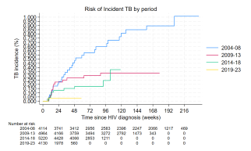
Tuberculosis incidence among people with HIV on antiretroviral therapy (ART) in Spain fell from 9.1 to 0.2 cases per 1000 person-years between 2004 and 2023, one of the steepest declines reported in HIV cohorts from high-income settings. Yet a residual risk persists, and tools to identify those who remain vulnerable are limited.
Using data from the nationwide CoRIS cohort, we examined which factors still predict tuberculosis among adults starting ART and whether a simple score could help identify individuals at risk. The residual risk was not evenly distributed: it was concentrated among people who inject drugs, those with lower educational attainment, those with very high viral load before treatment and those with a positive latent tuberculosis screening test. These findings suggest that immunological markers such as the CD4 count may no longer be sufficient on their own to capture tuberculosis risk in this setting. Combining these four factors into a predictive model showed good discrimination on internal validation and identified people at risk better than latent tuberculosis screening alone.
Overall, this study suggests that universal ART, early treatment initiation and comprehensive management of latent tuberculosis can bring tuberculosis among people with HIV close to elimination in a low-incidence setting. As cases become rare, the remaining risk is shaped largely by social vulnerability, viral load and latent infection rather than by immunosuppression alone. The proposed score offers a pragmatic tool to target preventive therapy and follow-up where they are most needed.
Why do you highligth this publication?
When tuberculosis becomes uncommon, the key clinical question is no longer how to reduce it overall, but who is still at risk. Current approaches based on screening tests or immunological markers alone may not be enough to answer it. By integrating social, virological and screening information into a simple score, this work offers a more precise way to stratify risk. It could help decide which patients benefit most from preventive therapy and closer follow-up, and for whom monitoring could be safely relaxed. Once externally validated, this approach could support a shift from universal to risk-based tuberculosis prevention in people with HIV.
Publication commented by:
Dr Roser Navarro-Soler & Dr Sergio Serano-Villar
INFECTIOUS DISEASES group. IRYCIS