Garrosa-Miró Y, Ortega P, de la Mata FJ, Malkoch M, Sanz Del Olmo N. Exploring the Antibacterial Potential of Bis-MPA Dendrimers Bearing Cu(II) and Zn(II) Complexes
Biomacromolecules. 2026
“By combining accessible, biocompatible and biodegradable building blocks with Cu(II) and Zn(II) complexes, this work opens a promising path toward fast-acting antibacterial metallodendrimers with potential to address antimicrobial resistance". - Dr Natalia Sanz del Olmo
Summary:
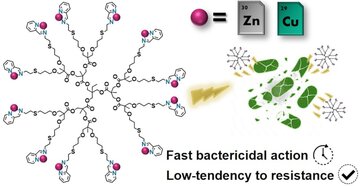
The rise of multidrug-resistant bacteria demands antimicrobial agents that act rapidly and durably. In this work, we aim to develop biodegradable and biocompatible antimicrobial systems by combining the versatile bis-MPA dendritic skeleton with the antibacterial properties of Zn(II) and Cu(II) complexes. The resulting metallodendrimers were synthesized using scalable bis-MPA scaffolds and systematically evaluated for antibacterial activity, cytotoxicity, resistance development and bactericidal kinetics. The dendrimers exhibit broad-spectrum antibacterial efficacy at low micromolar concentrations, with minimum inhibitory concentration values as low as 0.4 μM, while maintaining over 70% viability in fibroblasts and keratinocytes and showing no hemolytic activity toward erythrocytes at bactericidal doses. Second-generation Cu(II) and Zn(II) bis-MPA dendrimers eradicated Bacillus subtilis within 24 h and suppressed Pseudomonas aeruginosa within 4 h, without detectable resistance emergence and with superior activity to ciprofloxacin in the latter. Overall, the combination of rapid antimicrobial action, favorable cytotoxicity profiles, strain-dependent resistance behavior, and scaffold versatility highlights bis-MPA metallodendrimers as promising candidates for next-generation antimicrobial therapies.
Why do you highligth this publication?
This publication is particularly relevant because it demonstrates the potential of developing metallodendrimers from commercially available, biocompatible, and biodegradable building blocks. The use of bis-MPA dendritic scaffolds, together with readily available Cu(II) and Zn(II) salts with well-established biomedical potential, provides an attractive and economically accessible approach to the development of novel antibacterial materials. Beyond their intrinsic antibacterial activity against both Gram-positive and Gram-negative bacteria, these systems are particularly promising in the context of antimicrobial resistance. Their activity against Pseudomonas aeruginosa is especially noteworthy, as this clinically relevant pathogen can rapidly develop resistance to conventional antibiotics such as ciprofloxacin. Moreover, the study goes beyond conventional endpoint susceptibility assays by including time-kill experiments, providing a more dynamic assessment of antibacterial efficacy and bringing the evaluation closer to clinically relevant conditions. Overall, the work highlights promising and economically attractive platforms for the development of next-generation antimicrobial materials with potential relevance in the fight against antimicrobial resistance.
Publication commented by:
Dr Natalia Sanz del Olmo
DENDRIMERS FOR BIOMEDICAL APPLICATIONS group. IRYCIS