García-Regal C, Quiñones-Silva J, Martinez-Lorca A, Brox-Torrecilla N, Campos Mena S, Alonso-Gordoa T, Gómez-Ramírez J, Valderrabano P. Determinants of physicians' risk-benefit perceptions of adjuvant radioactive iodine for differentiated thyroid cancer
Endocrine. 2026
"Closing the Gap: Addressing Discrepancies Between Guidelines and Real-World Radioiodine Use in Thyroid Cancer". - Carlos García-Regal & Dr Pablo Valderrábano
Summary:
Purpose: Selective use of radioactive iodine is advocated in recent guidelines. We aimed to characterize clinical practice and factors associated with its prescription in low- or intermediate-risk differentiated thyroid cancer patients among Spanish physicians.
Methods: A cross-sectional survey was conducted in 2022 among Spanish physicians. The survey assessed preferences for radioactive iodine administration in different differentiated thyroid cancer clinical scenarios with excellent response to surgery.
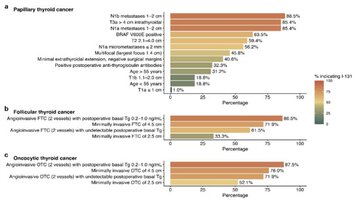
Results: Ninety-six responses were received. In low-risk differentiated thyroid cancer, radioactive iodine was most often used to facilitate follow-up (40%), or to reduce the risk of recurrence (23%). Activity of radioactive iodine was selected according to treatment intention by 96% of respondents; but more than 50% of low-risk differentiated thyroid cancer patients received radioactive iodine treatment in the clinical setting of 2/3 of the respondents; and 13% routinely recommend adjuvant activities in this setting. In intermediate-risk differentiated thyroid cancer, the main objective of radioactive iodine administration was to reduce the risk of recurrence (81-83%). Adjuvant radioactive iodine was perceived to be well or very well tolerated (96% of respondents); with a positive risk-benefit balance in patients with low-risk (50%) or intermediate-risk (90%) differentiated thyroid cancer. Factors influencing physicians' likelihood to recommend radioactive iodine included an overestimation of its benefits; and underestimation of its risks; and perceived increased risk with increasing tumor size, nodal involvement, BRAF V600E mutation, and follicular/oncocytic histology.
Conclusions: This survey shows discrepancy between reported clinical practice and current consensus guidelines as well as variation in practice patterns in Spain regarding [131I]NaI treatment.
Why do you highligth this publication?
This publication provides critical real-world insight into the persistent gap between evidence-based guidelines and routine clinical practice regarding adjuvant radioactive iodine treatment in low- and intermediate-risk differentiated thyroid cancer. By uncovering how physicians' perceived risk-benefit balance, overestimation of benefits, and specific pathological features drive overtreatment, this study highlights the urgent need for targeted educational initiatives and standardized decision-making to optimize selective, patient-tailored care.
Publication commented by:
Carlos García-Regal & Dr Pablo Valderrábano
DIAGNOSTIC TOOLS AND PRECISION MEDICINE IN THYROID PATHOLOGY. IRYCIS
This study was partly funded with a grant from the Community of Madrid (P2022/BMD-7379- iTIRONET-CM) and a grant from the Scientific Foundation of the Spanish Association Against Cancer (CLSEN258522VALD)