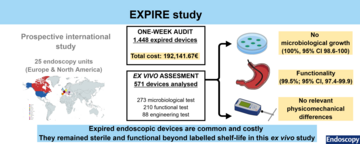
Rodríguez de Santiago E, Villaescusa D, Gómez de la Pedrosa E G,..., Soria F, Vilariño G, Pons V, Garcia Garcia de Paredes A, Ros O, Tort I, Triantafyllou K, Lemmers A, Dinis M, Pons FR, Henniger D, Vázquez E, Campillo A, Lorenzo V. Expired endoscopic devices remain sterile and functional: an international multicentre study challenging current shelf-life criteria
Endoscopy. 2026
“Expiration does not necessarily mean deterioration. Every year, unused medical devices are discarded simply because their shelf life has ended. EXPIRE challenges this practice by showing that expired devices retain sterility and functionality, calling into question current shelf-life criteria". - Dr Enrique Rodríguez de Santiago & Dr David Villaescusa Arenas
Summary:
Background and study aims: Expired medical devices represent an environmental and economic concern, yet their magnitude and true shelf life remain poorly defined. We aimed to quantify the volume and cost of expired endoscopic devices and evaluate their sterility and functionality beyond the labelled expiry date.
Methods: We conducted an investigator-initiated, prospective study (December 2023-May 2025) across 25 endoscopy units from Europe, Canada, and the USA. Expired devices were inventoried during one-week audits. An institutional questionnaire assessed storage practices. Microbiological sterility and ex vivo functionality were assessed in randomly selected samples. Physicomechanical testing included matched case-control comparison with non-expired counterparts.
Results: We identified 1,448 expired devices (median per centre, 42; range 3-262), with an estimated cost of €192,141.67. Of these, 273 underwent microbiological testing, 210 ex vivo functional assessment, and 57 physicomechanical evaluation. No microorganism growth was detected in any evaluated device (100%, 95% CI 98.6-100). All but one overtube retained functionality (99.5%; 95% CI 97.4-99.9). Physicomechanical testing showed no clinically relevant differences compared with non-expired devices. Only six centres (24%) reported written protocols to minimise accumulation of expired accessories, and three (12%) had electronic tracking systems.
Conclusions: Expired endoscopic consumables are frequent and costly, with suboptimal inventory management within endoscopy units. In this multicentre bench and ex vivo study, analysed devices preserved sterility and functional performance beyond their labelled expiry dates. These findings challenge current shelf-life assumptions and support further regulatory evaluation, but should not be interpreted as evidence supporting routine clinical use of expired devices.
Why do you highligth this publication?
We highlight this publication because it represents the first international multicentre study to quantify the burden of expired gastrointestinal endoscopic devices and systematically assess their sterility and functionality. Our findings demonstrate that the evaluated devices maintained sterility and functional performance beyond their manufacturer-labelled expiry dates, challenging current shelf-life assumptions. These results provide novel evidence to support further research into medical device expiry criteria and promote more sustainable and cost-effective healthcare practices.
Publication commented by:
Dr Enrique Rodríguez de Santiago & Dr David Villaescusa Arenas
LIVER AND DIGESTIVE DISEASES GROUP. IRYCIS