Martínez E, Escobar A, Di Palma F, Cavalli A, Alcázar A. ISQ201, a neuroprotective agent in ischemic stroke, is a novel activator of protein synthesis via allosteric binding to translation factor eIF4E
Int. J. Biol. Macromol. 2025
"Turning Protein Synthesis Back On After an Ischemic Stroke: ISQ201 Opens a New Neuroprotective Pathway". - Dr Emma Martínez & Dr Alberto Alcázar
Summary:
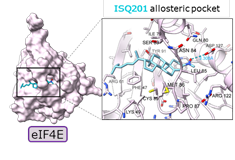
Eukaryotic Initiation Factor 4E, eIF4E, constitutes a main regulator of translation recovery, which determines tissue viability after transient cerebral ischemia. In this work, we studied the effect of ISQ201, an antioxidant neuroprotective compound, on protein synthesis in primary neuronal cultures subjected to oxygen-glucose deprivation and in a transient cerebral ischemia model in rats, obtaining evidence of its activity as a translation reactivator, including in the vulnerable region after the ischemia. The investigation of the underlying molecular causes through the analysis of the regulation factor eIF4E together with the levels of its associated proteins, eIF4G and 4E-BP1/2, revealed both a decrease in the translation repressor eIF4E-4E-BP2 complex formation and increasing levels of the eIF4E-eIF4G active complex in the presence of ISQ201. Binding of ISQ201 onto eIF4E was ascertained by SPR studies, and its allosteric binding mode was determined by molecular docking and molecular dynamics, and confirmed by functional studies in combination with allosteric inhibitor 4EGI-1. These results constitute the first evidence of protein synthesis (re)activation as a therapeutic approach for the treatment of ischemic stroke, making ISQ201 a starting point for further drug development in the context of diseases in which reduced translation rates may be crucial.
Why do you highligth this publication?
This publication provides the evidence that reactivating protein synthesis can be a viable therapeutic strategy for ischemic stroke. We show that ISQ201 directly binds to eIF4E through a novel allosteric mechanism, restoring the cellular translation machinery after ischemic injury and promoting recovery in vulnerable brain tissue. Beyond identifying a new mechanism of action for ISQ201, our findings open a new pathway for the development of drugs for stroke and other diseases in which impaired protein synthesis contributes to tissue damage and poor recovery.
Publication commented by:
Dr Emma Martínez Alonso & Dr Alberto Alcázar González
NEUROPROTEINS-STROKE. IRYCIS