Garcia C, Quiñones J, Brox N, Martinez A, Ruz I, Arias HP, Manso SA, Garcia AM, Rosillo M, Luengo P, Guerrero BP, García Gómez Muriel MI, Casado CF, Pamplona MJ, Lázaro VA, Paja M, Guijarro de Armas MG, Bolaños PI, Valderrabano P. Outcomes of patients with low-risk differentiated thyroid cancer with an excellent response to initial therapy
Eur Thyroid J. 2026
“Less is More: Streamlining Low-Risk Thyroid Cancer Follow-Up". - Carlos García-Regal & Dr Pablo Valderrabano
Summary:
Objective: Patients with differentiated thyroid carcinoma (DTC) classified as low risk of recurrence and an excellent response to initial treatment should have a particularly low risk of recurrence. Our objective was to assess the recurrence rate in these patients to support follow-up de-escalation.
Methods: A multicenter retrospective study was conducted in six Spanish hospitals, including consecutive patients diagnosed with low-risk DTC between 2015 and 2018 with an excellent response to initial therapy.
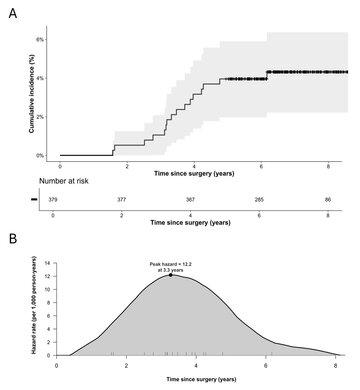
Results: A total of 379 patients were included, with a median follow-up of 6.7 years. Response to therapy at the last follow-up, according to the 2015 ATA/Momesso criteria, was excellent in 349 patients (92.1%), indeterminate in 29 (7.6%), and biochemical incomplete in 1 (0.3%). The overall incidence of indeterminate response was 11.8 events per 1,000 person-years, peaking at year 3 of follow-up and dropping to nearly zero after year 7. PTC and RAI treatment were associated with a lower probability of developing an indeterminate response (P = 0.02 and P = 0.03, respectively). When applying the 2025 ATA criteria, the excellent response rate increased to 95.8% and neither papillary histology nor RAI treatment was significantly associated (P = 0.07 and P = 0.61, respectively). During follow-up, indeterminate/suspicious findings on ultrasound were observed in 39 patients (10.3%). FNA was performed in 20 of these, none of which found recurrence.
Conclusions: Recurrences in patients with low risk of recurrence and an excellent response to initial therapy are extremely infrequent. These data support follow-up de-escalation in this population.
Significance statement: In this multicenter retrospective study of low-risk DTC patients with an excellent response to initial treatment, no recurrences were observed among 379 patients after a median follow-up of 6.7 years. The overall incidence rate of indeterminate response was 11.8 events per 1,000 person-years, peaking around year 3 after surgery and progressively declining thereafter, approaching zero after year 7. Using the 2025 ATA response-to-therapy criteria, 95.8% of patients maintained an excellent response at the last follow-up, and no variable was associated with the development of an indeterminate response. These findings support follow-up de-escalation.
Why do you highligth this publication?
We provide robust real-world validation for the 2025 American Thyroid Association (ATA) guidelines. Our results strongly support the safe de-escalation of surveillance of patients with low-risk differentiated thyroid cancer (DTC) who achieve an excellent response to initial therapy, paving the way toward earlier patient discharge.
Publication commented by:
Carlos García Regal & Dr Pablo Valderrábano Herrero
DIAGNOSTIC TOOLS AND PRECISION MEDICINE IN THYROID PATHOLOGY. IRYCIS
This study was partially supported by a grant from the Regional Government of Madrid (P2022/BMD-7379 - iTIRONET-CM) and by a grant from the Scientific Foundation of the Spanish Association Against Cancer (AECC Scientific Foundation; CLSEN258522VALD)