Martin-Moro F, Alcoceba M, Romero S, Marquet-Palomanes J, Alonso D, Astibia-Mahillo B, Andreu R, Perez R, Rodríguez-Martín E, De Ramon C, Solano I, Martin Garcia A, Piris-Villaespesa M, Blanco O, Roldán-Santiago E, Garcia JA, Subira D, Navarro A, García-Cosio M, García-Vela JA, López-Jiménez J. Phenotypic Characterization of Richter Transformation and De Novo Diffuse Large B-Cell Lymphoma With or Without Monoclonal B-Cell Lymphocytosis
Mod Pathol. 2026
"Immunophenotypic evaluation is essential for accurate diffuse large B-cell lymphoma characterization, optimal treatment, and recognition of Richter transformation". - Dr. Fernando Martín Moro & Dr. Fco. Javier López Jiménez
Summary:
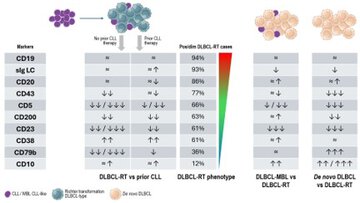
Richter transformation diffuse large B-cell lymphoma type (DLBCL-RT) is a biologically complex process that requires a comprehensive workup for an accurate diagnosis. Detailed information regarding DLBCL-RT immunophenotype is limited. We used multiparametric flow cytometry and immunohistochemistry to assess the phenotypic profile of 63 patients diagnosed with DLBCL-RT. Cases partially retained the immunophenotype of the previous chronic lymphocytic leukemia (CLL), although modulation of markers, such as CD43, CD5, CD200, CD23, and CD38, was common. Moreover, the phenotype of DLBCL-RT differed according to prior exposure or not to CLL therapy, with treatment-naïve patients showing more immunophenotypic variations against prior CLL compared with those who received therapy before transformation. With respect to the prognostic impact of antigenic markers, cases expressing CD20 exhibited higher overall survival compared with CD20-negative cases, whereas CD43 expression was associated with worse prognosis. DLBCL-RT cases exhibited several antigenic differences in CLL-associated markers compared with an independent cohort of nontransformed DLBCL without concurrent CLL-like monoclonal B-cell lymphocytosis (MBL) (n = 28). In contrast, a separate cohort of patients with de novo DLBCL and concomitant CLL-like MBL (n = 25) exhibited biological similarities to DLBCL-RT, including comparable phenotypic profiles and a high rate of clonal relatedness between MBL and DLBCL. We conclude that DLBCL-RT is associated with a CLL-like immunophenotype influenced by pre-existing CLL characteristics, and we propose that, in some cases, de novo DLBCL with concomitant MBL may be considered as RT.
Why do you highligth this publication?
- This study provides one of the largest phenotypic characterizations of DLBCL-RT and its comparison with the underlying CLL clone.
- DLBCL-RT shows a CLL-like phenotype, distinct from de novo DLBCL, and potentially shaped by prior CLL therapy.
- Expression of CD20 and CD43 is associated with prognosis in DLBCL-RT.
Publication commented by:
Dr. Fernando Martín Moro & Dr. Francisco Javier López Jiménez
TRANSLATIONAL HAEMATOLOGY. IRYCIS