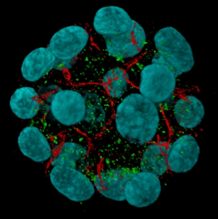
Baonza G, Alfonso T, Quintana C, Herranz G, Gordillo C, El Mazjoub Y, Escudero LM, Míguez DG, Martí E, Martínez N, Martín-Belmonte F. The V-ATPase/ATG16L1 axis drives membrane remodeling during epithelial morphogenesis
Nat Commun. 2026
"Neural Tube Organoids Reveal a Hidden Autophagy Pathway Essential for Neural Tube Formation". - Gabriel Baonza & Dr Fernando Martín-Belmonte
Summary:
Epithelial tubulogenesis shapes organs by transforming unpolarized epithelial cords into hollow tubes with central lumens. Posterior neural tube formation during secondary neurulation requires tightly coordinated membrane remodeling for de novo lumen formation and resolution, yet the role of autophagy in this process remains unclear. Autophagy operates through canonical and noncanonical pathways. While canonical autophagy is primarily degradative, the V-ATPase/ATG16L1-dependent Conjugation of ATG8 to Single Membranes (CASM) regulates LC3 lipidation on endocytic compartments. Using human neural tube organoids, MDCK cysts, and epithelial tube micropatterns selectively deficient in canonical or noncanonical autophagy, we demonstrate that CASM is essential for epithelial lumen resolution. Mechanistically, the V-ATPase/ATG16L1 axis coordinates junctional remodeling, phosphoinositide transitions, and Rab-dependent endocytic and recycling pathways to ensure single-lumen formation. These findings identify noncanonical autophagy as a spatially restricted membrane-remodeling mechanism that governs epithelial morphogenesis and reveal distinct, hierarchically balanced contributions of autophagy pathways during development.
Why do you highligth this publication?
This study identifies a type of noncanonical autophagy (CASM) as a fundamental mechanism controlling membrane remodeling during neural tube formation. By combining human neural tube organoids with advanced genetic and imaging approaches, the authors demonstrate how CASM coordinates endocytic trafficking to build a single neural tube lumen. The work provides new insights into the origins of neural tube defects and highlights the potential of organoid models to uncover developmental mechanisms otherwise inaccessible in humans.
Publication commented by:
Gabriel Baonza & Dr Fernando Martín-Belmonte
INTERNAL MORPHOGENESIS AND HOMEOSTASIS. IRYCIS