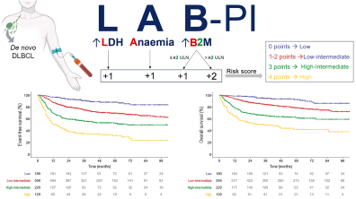
Martin-Moro F, Bento L, Marquet J, Browne SF, Gutierrez A, Diaz A, Sanchez J, Garcia JA, Salar A, Cordoba R, Novelli S, Rodriguez MJ, Gonzalez De Villambrosia S, Del Campo R, Luzardo HD, Garcia D, Garcia JA, Sancho JM, Abrisqueta P, Martin A, Grande C, Lopez J, Bastos M, Grupo Español de Linfomas/Trasplante de Médula ósea. Laboratory Prognostic Index (LAB-PI) in diffuse large B-cell lymphoma: a single blood analysis predicts outcomes as good as IPI, NCCN-IPI, and GELTAMO-IPI
ESMO Open. 2025
"A single blood test predicts outcomes in a Spanish cohort of more than 1,000 patients with diffuse large B-cell lymphoma". - Dr. Fernando Martín Moro
Summary:
Background: Many prognostic variables have been described in diffuse large B-cell lymphoma (DLBCL) and combined in prognostic scores, which are not usually fully objective and may be complex to apply. With the aim of designing and validating a simple, inexpensive, objective, and reproducible prognostic tool in DLBCL, the Laboratory Prognostic Index (LAB-PI) was developed.
Patients and methods: Laboratory parameters routinely evaluated at DLBCL diagnosis were analysed before treatment initiation in a DLBCL cohort (n = 221). The variables associated with event-free survival (EFS) were combined into the new score and graded according to their prognostic impact in multivariate analysis. Patients were clustered according to their risk. The LAB-PI was validated in an independent cohort (n = 885) and compared with other DLBCL scores.
Results: The LAB-PI included three laboratory variables routinely assessed at DLBCL diagnosis: elevated lactate dehydrogenase (LDH) (1 point), anaemia (1 point), and high β2-microglobulin (B2M) up to two times the upper limit of normal (ULN) (1 point) or greater than two times the ULN (2 points). Cases were clustered into four groups according to their prognosis in the validation cohort: low risk (0 points, 5-year EFS 87%), low-intermediate risk (1-2 points, 5-year EFS 69%), high-intermediate risk (3 points, 5-year EFS 55%), and high risk (4 points, 5-year EFS 37%). The LAB-PI was comparable with the International Prognostic Index (IPI), National Cancer Comprehensive Network (NCCN)-IPI, and Grupo Español de Linfomas/Trasplante de Médula ósea (GELTAMO)-IPI in predicting prognosis and remained useful in subanalysis according to age and stage.
Conclusion: The LAB-PI predicts outcome in newly diagnosed DLBCL patients by a single blood assessment including LDH, haemoglobin, and B2M.
Why do you highligth this publication?
- This is the largest Spanish cohort study analyzing prognosis in diffuse large B-cell lymphoma (DLBCL).
- A single blood test including LDH, Hb, and B2M predicts prognosis in newly diagnosed DLBCL.
- LAB-PI is an easy-to-apply, low-cost, objective, and reproducible prognostic score in DLBCL.
Publication commented by:
Dr. Fernando Martín Moro
TRANSLATIONAL HAEMATOLOGY. IRYCIS