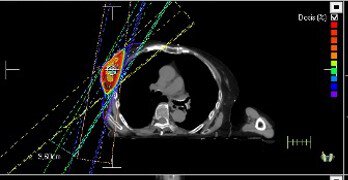
de la Pinta C, Gamero V, Muriel A, Capuz AB, Moris R, Martin M, Alarza M, Montero A, Muñoz MT, Hernanz R, García ML, Sancho S.. Phase I study of stereotactic ablative radiotherapy (SABR) in inoperable breast cancer
The Breast. 2026
"Ablative Radiotherapy Offers a New Non-Surgical Path for Frail Breast Cancer Patients". - Dr Carolina de la Pinta
Summary:
Purpose: A significant percentage of elderly patients with early-stage breast cancer are not surgical candidates or refuse surgery, and exclusive hormone therapy offers poor local control. SABR, by delivering biologically ablative doses in a few fractions, could be a non-invasive and effective alternative. This phase I clinical trial's primary objective was to determine the safety, tolerability, and maximum tolerated dose (MTD) of SABR as a definitive treatment in this population. Material and methods: A single-center, single-arm, phase I study was designed. Eligible patients were ≥70 years old with unifocal, T1-2N0 M0-1 breast cancer, considered inoperable or who refused surgery. A Fibonacci (3 + 3) dose-escalation design was used to deliver SABR to the primary tumor in 5 fractions. Dose levels were 36 Gy (Level 1), 38 Gy (Level 2), and 40 Gy (Level 3). The primary endpoint was dose-limiting adverse effects, defined as any ≥ Grade 3 events (per RTOG/ Harris scales) within the first 6 months. Secondary endpoints included local control (LC), progression-free survival (PFS), and overall survival (OS). Results: Between March 2021 and March 2024, 10 patients (11 tumors) with a median age of 91 years (range: 83-96) were enrolled. Three patients received 36 Gy, three received 38 Gy, and four received 40 Gy. With a median follow-up of 27 months (range: 4-40), no dose-limiting adverse events were observed in any cohort, and thus the MTD was not reached. No acute adverse events were recorded. The only late adverse effect reported was one case (10%) of Grade 1 subcutaneous fibrosis at 6 months in the 36 Gy level. Cosmetic outcome was excellent or good in 100% of patients. At 24 months, local control, PFS and OS were 100%, 90% and 90%, respectively. Conclusion: Definitive SABR for primary breast cancer in elderly and/or frail patients is an exceptionally safe and well-tolerated procedure up to a dose of 40 Gy in 5 fractions. Furthermore, it demonstrates promising preliminary efficacy with excellent disease control. SABR stands as a highly effective, non-invasive alternative to surgery or exclusive hormone therapy in this selected patient cohort, strongly supporting further investigation for efficacy in phase II studies.
Why do you highligth this publication?
This publication represents an important step forward in the treatment of a particularly vulnerable and often underrepresented patient population: elderly and/or frail patients with early-stage breast cancer who are not candidates for surgery or who refuse it.
This study addresses a clear unmet clinical need. In these patients, therapeutic options are often limited, and exclusive hormone therapy may provide insufficient local control. Our results show that definitive SABR can be delivered safely, without dose-limiting toxicities, with excellent tolerability and cosmetic outcomes, and with very promising disease control.
Importantly, this work supports the potential of SABR as a truly non-invasive, short-course, and effective alternative to surgery in selected patients. For this reason, we believe this publication is highly relevant, as it opens a new avenue for clinical research and may contribute to improving personalized treatment strategies for older and frail patients with breast cancer.
Publication commented by:
Dr Carolina de la Pinta Alonso
BIOMARKERS AND THERAPEUTICS TARGETS. IRYCIS