Rodríguez M, Martín E, Alonso P, Conde E, Pian H, Del Moral J, Alcharani N, Menacho M, Crespo L, Ramos ME, Zaragoza C, Rincón LM, Barderas MG, García-Bermejo ML. Dynamic microRNA Signatures as Biomarkers for Cardiac Ischemia and Remodeling
Int J Mol Sci. 2026
"Unveiling miocardial infarction: microRNA signatures as precise sentinels of ischemic cardiac damage and repair"
Dr. Elena Martín-García & Dr. María Laura García-Bermejo
Summary:
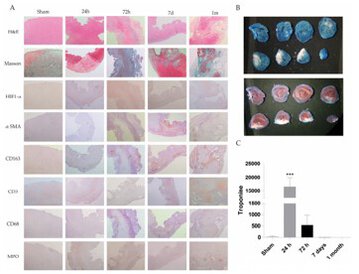
Myocardial infarction (MI) triggers complex pathological processes, including inflammation, hypoxia, and fibrotic remodeling. MicroRNAs (miRNAs) have emerged as promising biomarkers for cardiovascular injury; however, their expression dynamics along processes remain underexplored. We used an in vivo rat model of permanent coronary occlusion to study the molecular alterations associated with MI and its resolution in a temporal mode, including five experimental groups with five animals in each: sham, PO 24 h, PO 72 h, PO 7 d, PO 1 month. Histological analysis, serum biomarkers, and miRNA/gene expression profiles were analyzed in a time-dependent manner post-occlusion. Subsequent analysis revealed early depletion of selected circulating miRNAs (PO 24 h). Transient upregulation in cardiac tissue miRNAs, inflammatory and fibrotic gene expression (Fibronectin, Collagen, Vimentin, E-Cadherin) were observed at PO 72 h. These molecular alterations correlated with histological evidence of myocardial injury and repair. Taken together, our findings delineate the molecular timeline of MI progression and resolution and identify candidate miRNAs as sensitive and time-dependent indicators of myocardial stress, including miR-107, miR-122-5p and miR-221-3p. This integrative approach supports the use of miRNA signatures for noninvasive monitoring of cardiac injury and resolution and unveils potential therapeutic targets to reduce pathological remodeling.
Why do you highlight this publication?
This research provides a comprehensive molecular timeline of myocardial Infarction progression and resolution, in an experimental animal model mimicking human heart failure. By using an integrative approach, the study identifies a specific signature of microRNAs that serve as sensitive, time-dependent indicators of myocardial response to ischemia. These findings are crucial for developing non-invasive monitoring tools for cardiac injury and recovery, identifying new mediators to prevent maladaptive remodeling and long-term complications.
Publication commented by:
Dr. Elena Martín-García & Dr. María Laura García-Bermejo
BIOMARKERS AND THERAPEUTICS TARGETS. IRYCIS